Effective weed control is critical to the commercial success of any farming operation. In the US alone, weeds are estimated to cost farmers $33 billion in lost production each year. Today, farmers address this challenge by spraying herbicides across the entire field – even though weed infestation may be as low as 5%. As a result, not only are farmers spending far more money on herbicides than they need to, but millions of gallons are being needlessly sprayed each year. This is contributing to the mounting challenges posed by herbicide-resistant weeds, chemical drift, and soil and water contamination.
The Janzen family has been farming its land in Henderson, Nebraska, for three generations. Today, it manages approximately 5,000 acres of irrigated soybean, corn and corn seed. Operating in a way that is sympathetic to the environment has always been a crucial part of the family’s business ethos. As such, it has invested significantly in improving the sustainability of its operations.
This includes using remote soil moisture probes to monitor water use, and upgrading its grain drying facilities with more energy-efficient dryers. It has also looked into the feasibility of installing a solar plant to help lower both its energy costs and carbon emissions.
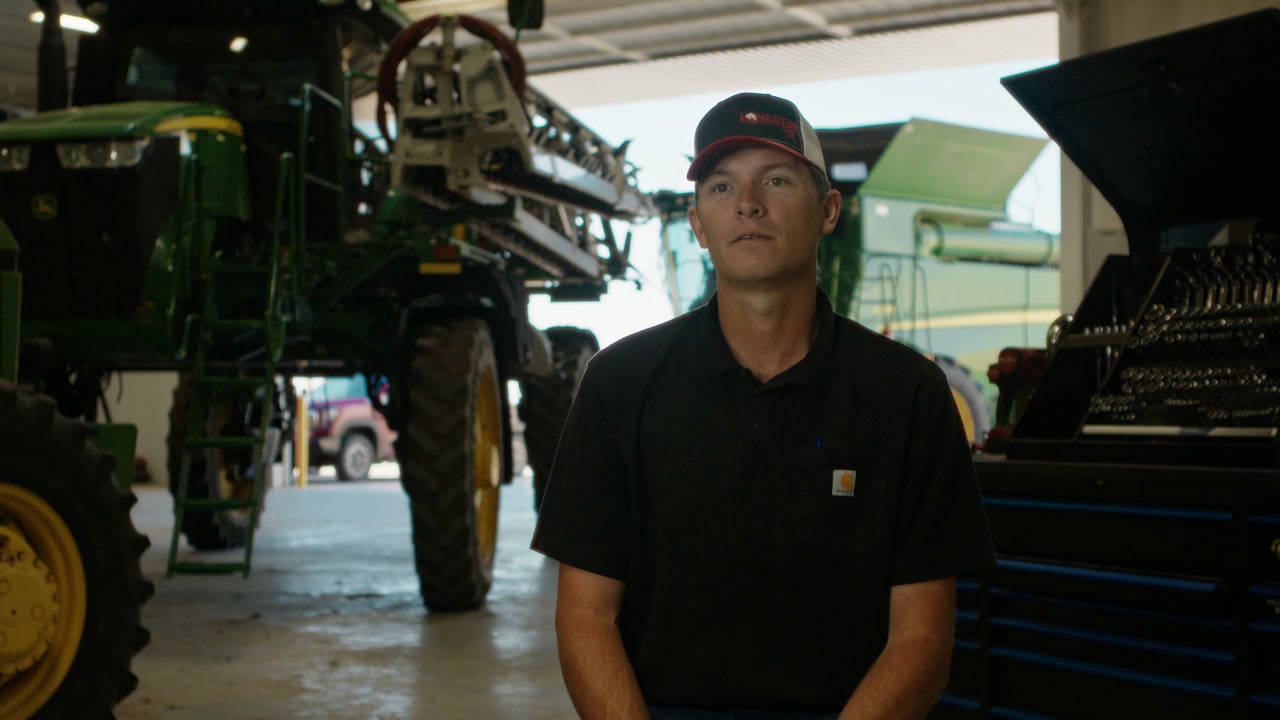
Reducing herbicide use is another important goal. However, for a long time, it seemed unachievable. Since joining the family business more than 15 years ago as lead sprayer operator, Brad Janzen has experienced first-hand the increasing challenges caused by herbicide resistance, especially during the last decade.
During this time Janzen Farms has tried many different methods to improve weed control efficacy. Initially, it increased the number of times each field was sprayed with Roundup from two to three times per season. When this no longer produced the desired results, it trialed new inputs, such as Enlist and Liberty. While these proved more effective, they also brought with them new challenges. For example, Liberty’s high water rate meant the sprayer operators had to make more frequent fill-ups, reducing their productivity.
“While the steps we have taken mean we have been able to keep one step ahead of the weeds and increase our yields year-over-year, my feeling is that we are not increasing them as fast as we should be,” says Brad. “There is also the bigger picture issue to consider, too. Quite simply, plant breeders are running out of modes of action to tackle resistance. It’s clear that a big change needs to happen.”
The situation came to a head in late 2021 when the unprecedented hike in input costs more than doubled Janzen Farm’s herbicide costs in a matter of weeks. The time had come for the family to take a stronger stand against weeds.
Determined to find a solution that would reduce herbicide use while also delivering efficacy on a par with broadcast spraying, Brad started to look beyond alternative inputs to alternative methods of application. The growing field of precision spraying technology seemed to offer a number of promising options. However, research showed that while each solution offered some advantages compared to broadcast application, almost all required a trade-off between cost reduction and efficacy. Further, they also required farmers to invest in a brand new sprayer, making them prohibitively expensive.
The exception was an artificial intelligence (AI) based solution developed by Greeneye Technology. Comprising onboard cameras to capture real-time images of the field, combined with proprietary deep machine learning capable of identifying more than 200 different species of weeds, it was proven to reduce herbicide use by up to 90%, while delivering the same efficacy as broadcast spraying. There were other features that caught the Janzens’ attention, too. Uniquely, the system was suitable for both pre- and post-emergence applications. It comprised a dual-product system to enable farmers to apply residual herbicides on a broadcast basis while applying non-residual herbicides precisely on weeds. Also importantly, it could be retrofitted to the operator’s existing sprayer, reducing the cost-of-entry considerably.
Keen to put Greeneye’s claims to the test, Brad signed up to become one of the company’s ‘early adopter’ farmers in the US, committing 3,000 acres to the program. Spraying was provided as a service, with each field sprayed twice – once during pre-emergence and again during post-emergence.
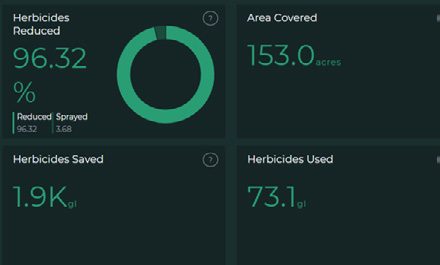
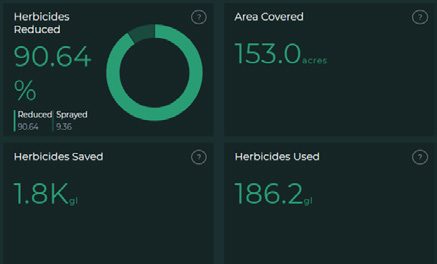
The result was an immediate and substantial reduction in Janzen Farms’ use of non-residual herbicides. Usage during pre-emergence was cut by more than 96% (as shown in the example in fig. 1). The system’s performance during post-emergence spraying also exceeded expectations, with more than a 90% reduction in herbicide use recorded (fig. 2).
In total, Janzen Farms estimates it has been able to cut non-residual herbicide use by almost 95%, equating to a cost saving of around $25/acre. Crucially, this was achieved with no drop in efficacy compared to broadcast spraying.
With the money it has saved, the farm is now able to invest in more efficacious inputs that were not affordable when sprayed on a broadcast basis. This is expected to deliver further improvements in weed control efficacy – helping to increase yields – and will play a major role in helping to overcome the blight of herbicide resistance.
There is no turning back for Janzen Brothers Farms. Following the success of its first season with Greeneye, it took the decision to purchase its very own system, which it began to utilize in 2023.
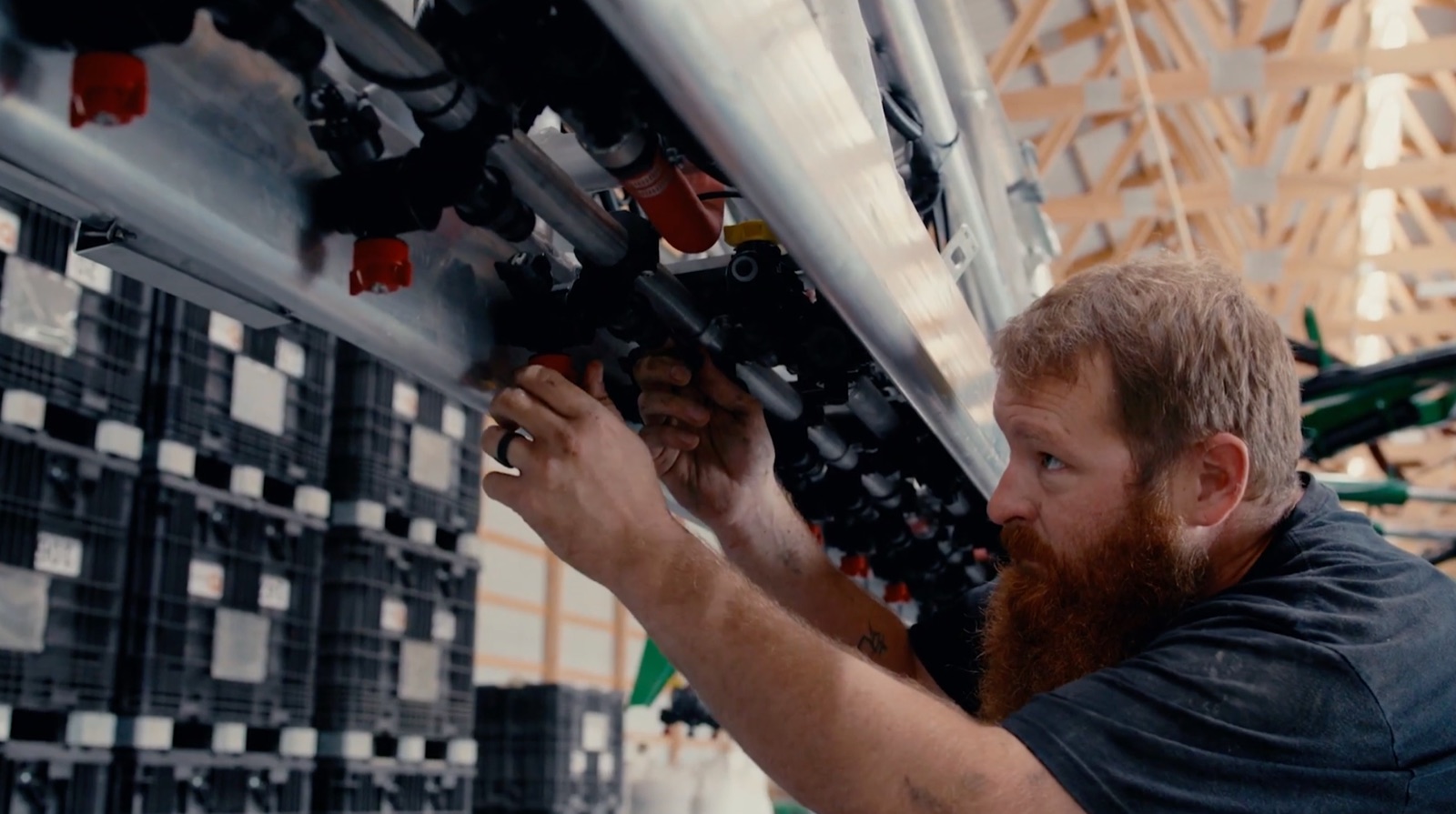
The system was supplied pre-mounted on a new aluminum spray boom retrofitted to Brad’s existing sprayer, a Hagie STS16 with a 120 ft. boom. Included are 24 cameras, 12 graphics processing units, 144 sprayer nozzles, and pulsating lights, allowing the Janzen family to run the sprayer day and night, if needed. In addition, a second input tank was installed on the sprayer to hold non-residual herbicides. Importantly, this gives the Janzens much greater flexibility to tackle a wide variety of weed-related challenges.
“Using the Greeneye system has really changed the game for us in terms of delivering more cost-effective and efficacious weed control,” says Brad. “A really important aspect of that is the flexibility it gives us to customise our weed management program dependent on the species of weeds we are targeting and the level of infestation, as well as other factors such as soil and weather conditions. For example, the dual-tank system means we have the option to broadcast residual herbicides while using the second tank for spot spraying more powerful inputs. That’s absolutely critical for us.”