Quantify reductions in post-emergence herbicide use with targeted spraying relative to broadcast application.
Assess how standard and stronger pre-emergence residual programs influence savings.
Evaluate savings from programs combining broadcast and targeted application.
Field evaluations conducted from 2024 through 2025 examined Greeneye Technology’s AI-powered targeted spraying system in soybean production, including opportunities to reduce post-emergence herbicide use. The research compared conventional broadcast applications, targeted applications, and programs combining the two approaches, while examining how different pre-emergence residual programs affected savings.
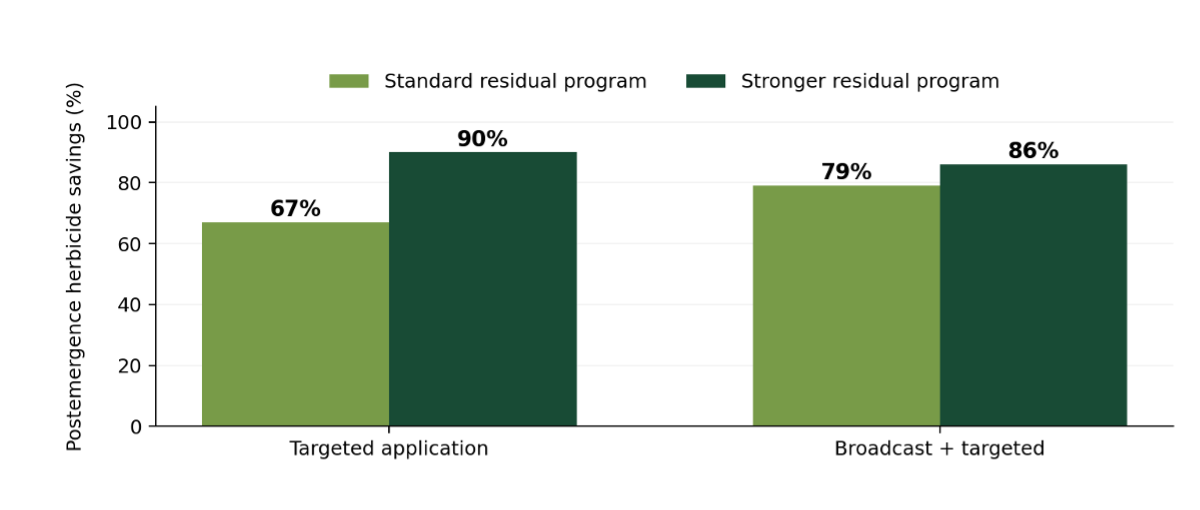
In the 2025 Nebraska soybean trial, the targeted application program saved 67% of postemergence herbicide following a standard residual program and 90% following a stronger residual program. Programs combining broadcast and targeted application saved 79% and 86%, respectively.
The study's broader summary reports 60–87% post-emergence herbicide savings across its multi-season research.
Substantial savings are achievable. Greeneye reduced post-emergence herbicide use by as much as 90% in the 2025 Nebraska fields.
Residual programs matter. The stronger pre-emergence residual program increased savings in the targeted-only comparison, from 67% to 90%.
There is flexibility in application strategy. Combined broadcast and targeted programs retained meaningful savings of 79% and 86% under the two residual approaches.
Weed pressure affects the opportunity. Savings depend on field conditions and program selection; where weeds require near-full-field treatment, savings can be limited.
Source: “From deposition accuracy to field scale weed control: A precision spraying framework for soybeans,” ACS AGRO presentation, August 24, 2026.