
University of Nebraska–Lincoln researchers evaluated whether camera-guided targeted (spot) spraying could deliver weed control comparable to traditional broadcast applications while reducing non-residual herbicide use. The peer-reviewed study included a 2022 corn trial near Clay Center, Nebraska, using Greeneye Technology’s system and a separate 2023 soybean trial near Mead, Nebraska, using John Deere See & Spray. Together, the trials illustrate how weed pressure and herbicide programs influence outcomes.
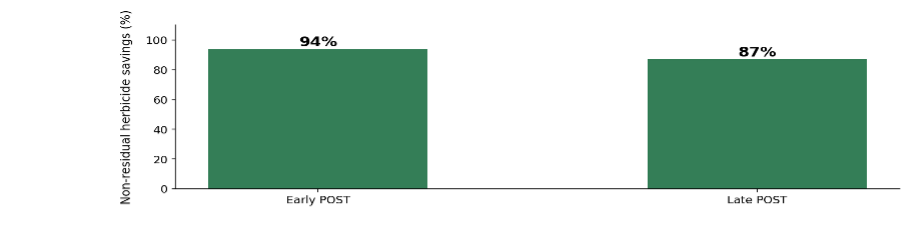
In the 2022 trial, Greeneye’s dual-tank/dual-line targeted spraying system, retrofitted onto a Hagie STS12, was evaluated in corn following a residual herbicide program. Researchers applied early- and late-postemergence treatments on May 17 and June 13, respectively, comparing residual-only broadcast, residual broadcast plus targeted non-residual spraying, and full broadcast treatments. Low weed pressure allowed the targeted system to apply non-residual herbicides only where needed, saving 94% at early POST and 87% at late POST.
Greeneye reduced non-residual herbicide use by 94% early POST and 87% late POST.
At 21 days after late POST, the targeted and full-broadcast programs were not significantly different for either weed species.
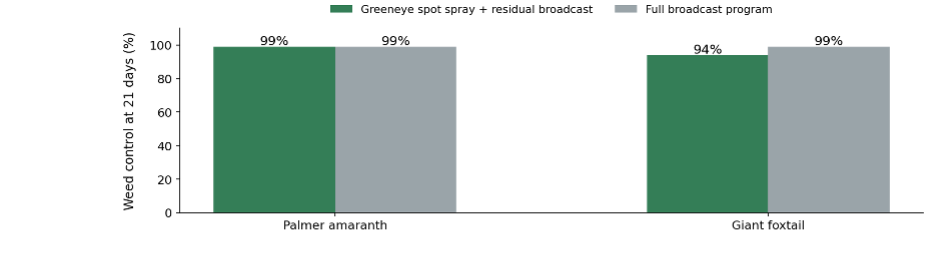
At 21 days after late-postemergence application, the Greeneye targeted treatment achieved 99% Palmer amaranth control and 94% giant foxtail control, compared with 99% for both weeds under the full broadcast program. These differences were not statistically significant. Corn yield was also statistically similar between targeted and full broadcast treatments (16,867 versus 17,219 kg/ha).
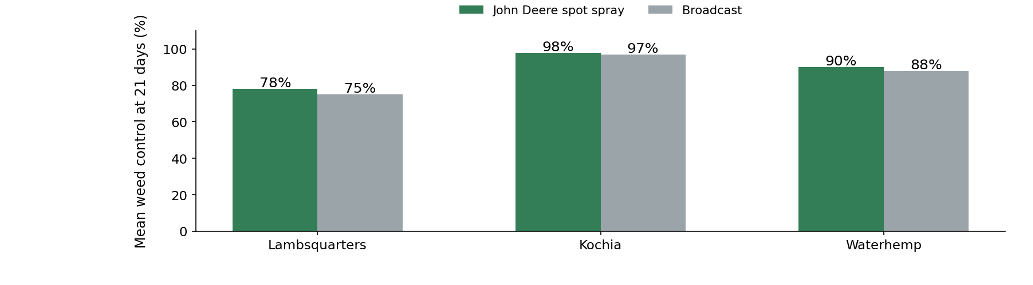
In the separate 2023 soybean trial, researchers evaluated John Deere See & Spray in a field with substantially greater weed pressure. Treatments began at planting on May 9, followed by late-postemergence application on June 20. With no residual herbicide applied at planting, weed infestation increased. At 21 days after late POST, targeted and broadcast applications generally provided similar control of common lambsquarters, kochia, and waterhemp across the tested herbicide programs.
Across tested herbicide treatments, targeted and broadcast spraying achieved similar control of these weeds 21 days after late POST.
Targeted applications saved 1.1%–5.4% of non-residual herbicide at the early timing and none at late POST, as the high weed pressure required treatment across nearly the whole field. Soybean yields were generally comparable between targeted and broadcast application within herbicide programs. These results underscore that effective weed detection does not necessarily translate into large chemical savings when weeds are widespread.
Effective weed control comes first. Across both field trials, targeted applications generally provided weed control comparable to broadcast spraying. Researchers emphasize adequate herbicide coverage to limit escapes and weed seed production, rather than maximizing savings at the expense of control.
Residual programs help unlock savings. Layered residual herbicides helped keep infestation low in the 2022 corn trial, supporting 87%–94% non-residual herbicide savings. Without an early residual application in the 2023 soybean trial, heavier infestation limited savings to 0%–5.4%. Weed density, growth stage, and field coverage all affect savings potential.
Fit the technology into a complete weed management strategy. Effective early-season herbicide selection and control can improve opportunities for targeted spraying. Dual-tank systems offer flexibility to apply different chemical combinations simultaneously through separate nozzles. The researchers note that the benefits vary by cropping system, herbicide program, and weed pressure, and that further research on additional dual-tank uses is warranted.
Source: Leise, A., et al. (2025). “Evaluating precision sprayers for targeted weed management in corn and soybean.” Agrosystems, Geosciences & Environment, 8, e70055. https://doi.org/10.1002/agg2.70055